Someone has asked you for something. Your mother wants to know about Christmas, or a friend needs another favour, or work has found one more thing for your Friday. You already know what your answer is. What you don't know is how to say it and then live with yourself for the rest of the evening, which is why you've typed how to set boundaries into a search box. Most of what comes up will promise you can do it without guilt. I did a whole radio show with that in the title. I'm going to be straighter with you here than the title was: with the people who matter to you, the guilt comes anyway. What I can show you is where to put the line, what to say, and what the guilt is for.
Doors With Handles on Both Sides
A boundary is the line that says what's okay for you and what isn't. Your time, your money, your energy, what you'll listen to, how you'll be spoken to. Most people have never once been asked where theirs are.
People hear the word and picture a wall. A wall keeps everybody out, including the ones you want near you. The picture I use is a door with a handle on both sides. It lets people in, safely, and it shuts. At the far end from a wall there's no door at all, which is where most people searching this have been living: everyone in, at any hour, because somewhere along the way kindness got confused with going along with things.
Two things about that door are worth getting straight before you try to use it.
A boundary is about what you will do. "I don't answer the phone after nine" is a boundary. "You have to stop ringing me so late" is an instruction to somebody else, and you've no way of enforcing it. I said on a show this summer that a healthy boundary shows people where the door is, and they decide whether to come through it respectfully. That part belongs to them.
And a boundary is a different thing from an ultimatum. Ultimatums threaten. Boundaries define. One says "if you do that again, this will happen". The other says "here's what I'm prepared to do, and here's what you can work within".

Checking Your Edges
You can't hold a line you can't find. So before the wording, an exercise I call checking your edges.
Bring to mind a recent moment when you said yes and everything else in you said no. Notice where that sat in your body. Tension across the shoulders, a heaviness in the chest, maybe a bit of resentment bubbling up. That's an edge, and you've just found it. Now run the same moment again, and this time you pause, take a breath, and say the true thing, calmly and kindly. Notice what's different.
If nothing comes to mind, which happens when the yes has been automatic for years, there's a tool I give clients. For one week, at the end of each day, take a piece of paper, put the date on it and answer two questions. What did I do today that I didn't want to do, who did I do it for, and why? And what was done for me today, by whom, and why did they do it? The point is to see on paper where your week is going, and I don't mean it as a way of building a case against anyone. Look for the names that keep coming up.

The Guilt Comes Anyway
Here's where I part company with my own show title, and with every article that ranks for this.
You find the line. You say it well. An hour later you feel terrible. Most advice treats that feeling as a fault in you, something to be trained out. The research says something more useful.
In 1994 three psychologists, Roy Baumeister, Arlene Stillwell and Todd Heatherton, reviewed the studies on guilt and concluded it's best understood as something that happens between people as much as inside them. It is strongest, most common and most consistent in close relationships, the kind where each of you expects the other to care. And it does a job there. It keeps people treating each other well, and it's one of the ways the person with less power in a relationship gets their way.
So you feel wretched saying no to your mother and nothing whatsoever saying no to a cold caller. The guilt is measuring how much the relationship matters to you. It has no opinion on whether you were right. And notice the last part of that finding, because it explains a lot of family life: guilt is a lever, and people who love you will pull it, often without knowing they're doing it.
That's why I've stopped promising anybody a boundary without guilt. I said on air in July that you cannot be fully yourself and never disappoint anyone, and the ones who feel it worst are the caring ones. Therapists even. When it arrives, you don't have to argue with it and you don't have to obey it. It's the relationship registering. Let it register.
They Mind Less Than You Think
The other thing going on in that hour is a forecast. You're predicting how they've taken it, and the forecast is nearly always a storm.
Two researchers, Julian Givi and Colleen Kirk, tested that forecast across a run of studies on people turning down invitations. The people saying no consistently overestimated how angry the other person would be, how much the refusal would look like not caring, and how unlikely they were to be asked again. The reason they found is the useful bit. The person declining assumes the other one is dwelling on the no itself. The person who asked is thinking more about what was going through your head when you decided.
I'll give you the limits. Those were invitations to lunch, a match, an evening out, and as far as I can find nobody has run the study on a parent in December. The published summary gives no sizes either, so I won't invent any. But the direction held across the studies, and it fits something I said on the show: if the person on the other end is the right kind of person, they'll accept it. That turns out to be true more often than the forecast allows.
If the no you're rehearsing is about Christmas, where you'll be and for how long, hold on to that. The ruined day in your head is the forecast talking.

The Sentence Itself
In an earlier post I said I don't start people on no. I start them on "I'll have to think about it", and if no is still too far a jump for you, start there. This is the rung after.
The sentence I gave on the radio was: "I'd love to help, but I can't take that on right now." It's kind, it's short and it's true. I'd still use it. But three pieces of research have made me fussier about the wording than I was that morning.
The first is about one word. Across four studies, people who framed a refusal as "I don't" rather than "I can't" felt more in charge of it and were more likely to stick to it. My reading of why: "I can't" sounds like something is stopping you, which invites the other person to remove the obstacle. "I don't lend money to family" shuts a door that "I can't at the moment" leaves on the latch. Those studies were about how people talk to themselves when they're resisting temptation, so carrying it over to your sister is my extrapolation.
The second is about excuses. I said on the show to say no politely, calmly and without justification, and the evidence backs the last part. In six studies, "I don't have time" came across as less trustworthy than an excuse about money and left the other person feeling less close, because people accept that money is less under your control than time is. The people giving the excuse didn't see that coming. If you give a reason, give the real one.
The third is about "I" statements, which are on my own tip list. They're fair advice. When researchers asked people to rate opening lines for a difficult conversation, "I" language was judged less hostile than "you" language. But the best-rated line of all had both people in it: I understand why you might feel that way, but I feel this way. Those were ratings of imagined scenarios. One small study of real arguments between young couples found that "I feel" on its own tended to get batted away, and landed when it showed some awareness of the other person. So: "I know you were counting on me, and I don't do Sundays any more."

Then practise, because none of this survives contact with a real person the first time. One small no a day for a week. Polite, calm, no explanation. Notice how it feels, and notice that the world doesn't end.
A No of My Own
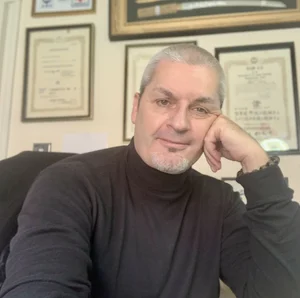
I started karate at eleven and it ran through my life for decades. I fought for my country, I coached the national squad, and I ended up as chairman of the association my teacher founded. Politics has always been karate's biggest weakness: too many egos, too many people who've lost sight of why they started. And I'll be straight with you, I allowed myself to get sucked into all of it. That was one of the main reasons I walked away from the formal organisations altogether.
I said on the show that if all you ever do is say yes, the yes means less. A no like that one is what makes the yes honest.
When They Push Back
Some people will. Anyone who's been trained to expect your yes goes through a transition of their own when it stops being automatic, and it isn't always graceful.
Two things matter here. Hold it the first time it's tested. As soon as somebody pushes a boundary and you give in, they conclude it didn't really mean anything, and so, quietly, do you. And forgive yourself the relapses. You'll have them. I'm not saying go out and say no to everybody. I'm saying there are a lot of times you want to and don't, and those are the ones to work on.
If the yes has been running so long that you're no longer sure what you'd want instead, that's a bigger piece of work than a sentence, and it's what my people-pleasing page is about.
One caution. Everything above assumes the other person will be disappointed, not dangerous. The people I see whose boundaries have been worn down furthest have often come out of a controlling relationship or a hard childhood, because boundaries are the first thing to get broken down there. If you're choosing your words because you're frightened of what happens next, a better sentence won't fix that, and the numbers below are for you.
If Things Are Worse Than That Right Now
Please do not wait for an appointment.
- If you or someone else is in immediate danger: 999
- NHS mental health crisis line for Milton Keynes, free, day or night: 0800 0234 650
- Urgent NHS help, choose the mental health option: 111
- Samaritans, free, at any hour: 116 123
- MK Crisis Cafe, run by Mind BLMK, open 5pm to 11pm every day: 01525 722 225
If you come and see me about this, I won't hand you a script. We'll find where your edges are, work out which no you've been putting off, and say it out loud in the room until it sounds like you.
Send me a messageOne small no this week. The guilt will turn up. Let it, and hold the line.